


Fireboy DML, whose last full-length project was Adedamola in 2024, has returned in the fall of 2026 with ZUKO!, his fifth studio album. But before this project, he has had a series of singles and features, including his appearance on Joyner Lucas’ project and his collaboration with Pheelz.
Now, two years after Adedamola, Fireboy is back with a 13-track project that sees him explore different sounds while maintaining what has always made him a good artist: his songwriting, vocals and ability to compile a body of work that makes sense from beginning to end.
But the question is, does ZUKO! do enough to take him out of the shadow of his previous projects, particularly Laughter, Tears and Goosebumps (LTG)?
Let’s get into it.
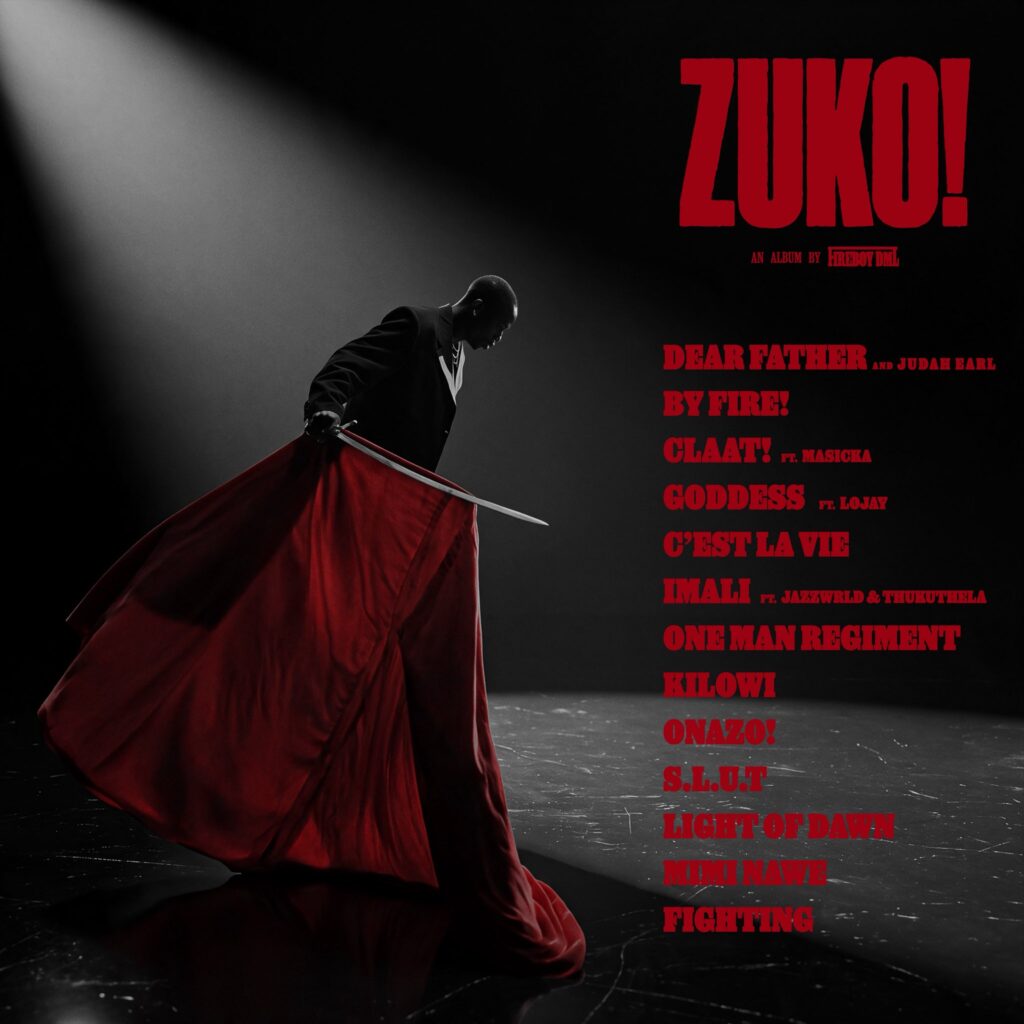
Dear Father: A Perfect Album Opener
Dear Father, featuring Judah Earl, opens the album, and what a perfect opener that also doubles as a prayer for guidance from the supernatural. Of course, Fireboy is not afraid to use his voice for the ballad rendition, and he makes it work.
There is something about starting an album with a prayer that sets the tone for what is to come. It is not just about asking for guidance; it also introduces a man who understands that, irrespective of how much he has achieved, there are still things beyond his control.
And for an album titled ZUKO!, a title that references Prince Zuko from Avatar: The Last Airbender, a character whose journey revolves around identity, exile and redemption, the opening track feels appropriate. The album is already introducing us to someone who is trying to find his footing, even if he has to do so on his own terms.
The next song, By Fire!, gives us an upbeat Fireboy. He is someone who does not surrender to the norms and conventions. He is a revolutionary, and there is no barricade or hurdle he would not run over. If Dear Father is the man asking for guidance, By Fire! is the man ready to face whatever comes his way.
CLAAT! and GODDESS: Fireboy Enters the Dancehall Territory
CLAAT! features Jamaican dancehall artiste Masicka, and this is a venture into the dancehall territory. Who would have thought that Fireboy would eat this beat like an unprocessed meal and leave no crumbs?
The song is a testament to his versatility. We have seen Fireboy explore different sounds over the years, but there is always that question of how well he can adapt when he steps outside his usual territory. On CLAAT!, he gives us a convincing answer.
The song’s theme revolves around physical attraction and the chemistry that comes with two bodies moving together. Masicka’s presence also makes sense here, as the Jamaican artiste brings the dancehall flavour that the song needs. This is one of those collaborations where you can appreciate the decision to bring two different musical backgrounds together.
GODDESS, featuring the money-earning Lojay, takes us back to familiar territory. Both men are in love with their lovers’ bodies, and what is a goddess’ body without putting you in a mesmerised box?
Fireboy and Lojay are no strangers to making music together, and their voices complement each other well. They understand the assignment, and the song does not feel like a collaboration that was forced simply because both artistes needed to be on the same track.
C’est La Vie doubles down on the previous theme, but there is a slight tone of unrequited love. This time, Fireboy accepts what has happened without complaints. There is a difference between wanting someone and accepting that things might not work out the way you want them to. The song leans into that feeling, and Fireboy makes it sound as though he has made peace with the situation.
IMALI: A South African Detour
IMALI takes us to South Africa and continues the adoption of the 3-step beat, featuring JAZZWRLD and Thukuthela.
This is another instance of Fireboy exploring sounds outside the Afrobeats territory he is best known for. The collaboration is particularly interesting because it connects him to a musical movement that has continued to influence the wider African music scene.
JAZZWRLD and Thukuthela are not there merely to decorate the song with their names. Their involvement gives the record its Southern African identity, allowing Fireboy to work within a different rhythmic framework.
And considering how easily African sounds travel across borders these days, it is a welcome addition to the album. Fireboy is not necessarily trying to abandon his identity; he is showing that his music can accommodate other influences without losing its appeal.
One Man Regiment, Kilowi and S.L.U.T: Desire Takes the Wheel
One Man Regiment is a testament to agility and consistency. There is a certain determination in the title itself, the idea of being an army of one and having to hold your own without depending on anyone else.
Kilowi talks about desire, while S.L.U.T (Sex Love Understanding Trust) has no definition aside from what the song title already says it should be. Fireboy is asking for closure and whatever goodies should come with being in a relationship.
And really, what else is there to explain when the title has already spelt out the ingredients?
Fireboy has always been good at writing about relationships, desire and the complications that come with loving someone. From the lover boy we met on Laughter, Tears and Goosebumps to the more confident persona he has explored on subsequent projects, these themes have remained part of his musical identity.
The difference is that he is no longer approaching them from exactly the same position. There is more confidence here, and he seems comfortable exploring the different sides of attraction without having to package himself as the innocent lover boy all the time.
Light of Dawn and Mimi Nawe: The Vulnerable Side of ZUKO!
Light of Dawn talks about vanities, but to Fireboy, these are necessary vanities, and he would like to enjoy himself with them, irrespective of whether his sight is clear or intoxicated with his woman.
There is a difference between acknowledging that material things are temporary and deciding that you still want to enjoy them while you can. Fireboy seems to understand that distinction. He is not necessarily pretending to be above the things that make life pleasurable.
Mimi Nawe is about longing and attachment, a plea for companionship and the fear of abandonment. And this is where Fireboy’s songwriting comes into play again.
For all the confidence and bad-boy energy he brings to other parts of the album, he still understands how to communicate vulnerability. He knows that there is a difference between wanting someone physically and wanting that person to stay.
It is one of the reasons Fireboy has remained an interesting artiste to follow. He can sing about desire without losing the emotional component that makes his songs relatable.
Fighting: A Fitting Conclusion to ZUKO!
Fighting talks about his journey and how ruthless the road is. All he knows is that he has to keep coping and adapting.
“…I’m still fighting for my life, I’m still a soldier…”
And what a perfect way to close the album.
After taking us through prayer, confidence, desire, romance and the enjoyment that comes with being alive, Fireboy ends on a note of perseverance. The journey has not been easy, and there is no guarantee that things will suddenly become easier. All he can do is keep fighting.
It also brings us back to the idea introduced in Dear Father. The album begins with a plea for guidance and ends with a man who understands that he still has to keep going.
That is a good way to bring a project to a close. Rather than simply ending with another song about love or attraction, Fireboy gives us something that feels connected to the bigger picture.
Is ZUKO! Another LTG? The Problem With Having a Peak Debut Album
This album is not necessarily meant to get the global reach, neither was it made to compete with other projects. But the problem with having a peak debut project is that you are judged by that metric. If your next project does not challenge the already existing one, it has to be a balancing act, and that is Fireboy’s fate.
Laughter, Tears and Goosebumps was a defining project for Fireboy. Released in 2019, it introduced listeners to a singer who understood the art of making love songs sound sincere, catchy and relatable. Songs like Jealous helped establish his identity, and the album created expectations that would follow him for years.
Then came APOLLO, Playboy and Adedamola. Each project had its own direction, but the question of whether Fireboy could recreate the magic of LTG never really went away.
All Fireboy has done is try to step away from the shadow he cast on himself with LTG, that persona. He tried it with Playboy a bit and caved with Adedamola. But with ZUKO!, he has gone full throttle bad boy. He has shown that he can also be dangerous while being vulnerable in songs like Dear Father, which introduces the project, and Fighting, the outro.
And that is what makes ZUKO! interesting to me. Fireboy is not abandoning the things that made him a good artiste. Instead, he is allowing himself to explore other sides of his personality.
The lover boy is still there, but he is no longer the only person in the room.
Final Verdict: Fireboy DML Still Knows How to Make an Album
Fireboy sure knows how to compile a project, and ZUKO! is a good project.
Would it get him that global and local hit? Definitely not, at least not based on what I have heard. But then again, does every album have to produce a hit single to justify its existence?
Fireboy does not seem overly concerned with chasing that outcome here. If he were, he could have given in to the cries of the public and fans for a big-name artiste to appear on the album. Instead, he has opted for collaborations that serve the music, bringing together Masicka, Lojay, JAZZWRLD, Thukuthela and Judah Earl.
That does not automatically make the album better, but it tells you something about the direction he wants to take.
More importantly, Fireboy continues to show that he is a good songwriter and a project artiste. He understands how to put songs together, how to move between different themes and how to make an album feel like more than a collection of singles.
Is ZUKO! going to replace LTG as his best project? I doubt it. But that is not the only way to measure what he has achieved here.
For me, this is Fireboy making a conscious effort to move beyond the expectations that have followed him since his debut. He is still the same artiste who understands love and vulnerability, but he is also more willing to embrace the dangerous, confident and sometimes reckless side of himself.
And that is a welcome development.